

Bachelor of Science in Astrophysics Course Requirements at University of Cape Town
University of Cape Town · Faculty of Science
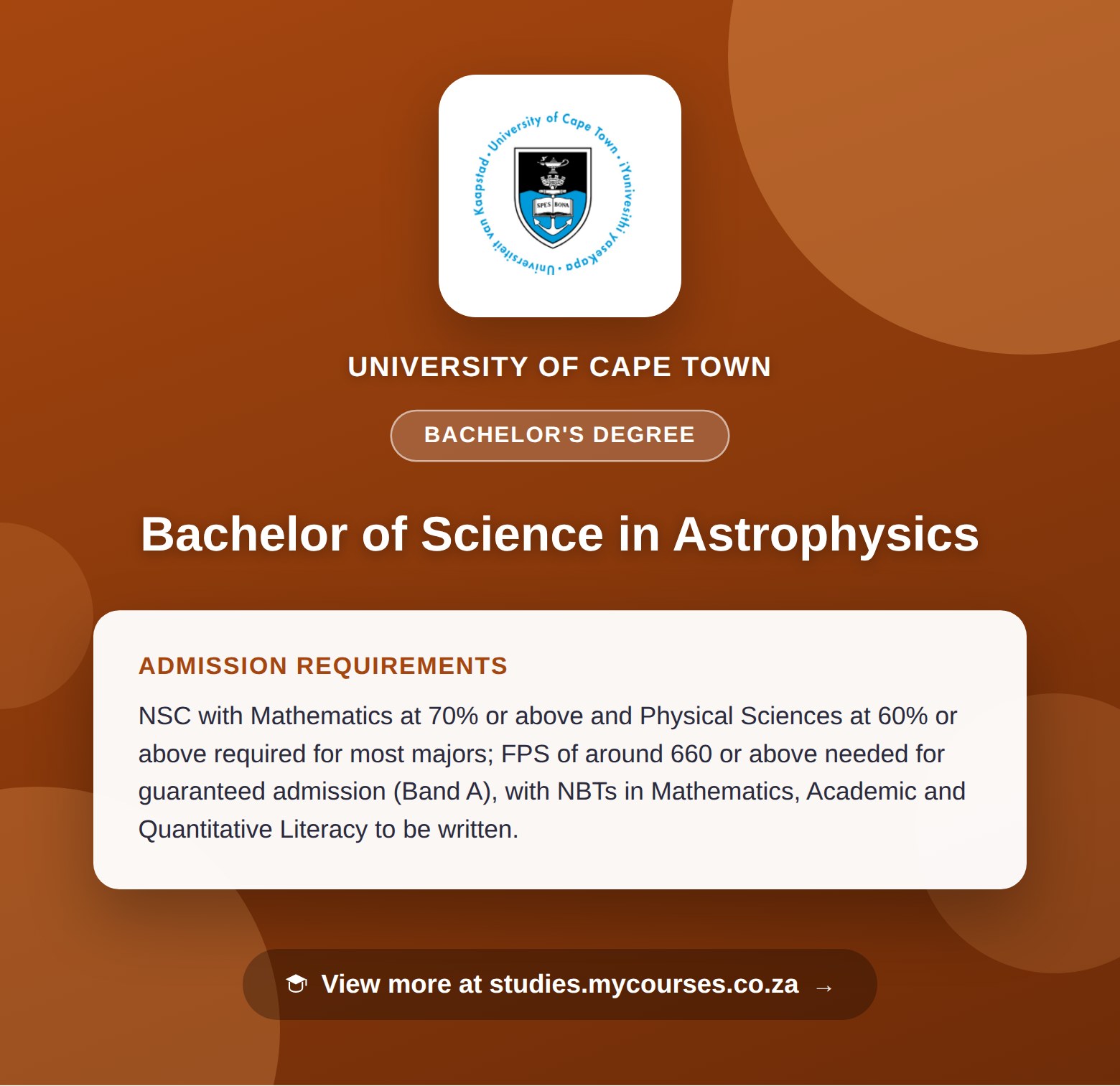
The Bachelor of Science in Astrophysics is a bachelor's Degree offered by University of Cape Town for 2027 learners, taking 3 years (4 years extended) to complete. This page covers the Grade 12 subjects and admission score you need to qualify, what the course involves, where you can study it, the careers it leads to, and how to apply.
Grade 12 Required Subjects to study Bachelor of Science in Astrophysics at University of Cape Town
NSC with Mathematics at 70% or above and Physical Sciences at 60% or above required for most majors; FPS of around 660 or above needed for guaranteed admission (Band A), with NBTs in Mathematics, Academic and Quantitative Literacy to be written.
About this course
This major builds a strong foundation in mathematics and physics before moving into observational and theoretical astronomy, including night-sky observation sessions. Students progress from introductory astronomy to studying the physical processes behind astronomical phenomena. It suits students aiming for research careers in physics or astronomy.
Possible careers
How to apply for 2027 studies
Apply directly through UCT's own online application system (applyonline.uct.ac.za); this listing does not process applications.
Course intelligence for Bachelor of Science in Astrophysics
Data-driven planning insights for this specific course: job market outlook, NSFAS funding, and how competitive admission is likely to be.
Job market outlook
Bachelor of Science in Astrophysics doesn’t currently appear on the national scarce-skills list as an Astronomer. That’s not a red flag on its own, most jobs in South Africa aren’t on that list, it just tracks where employers reported the strongest hiring pressure. Your own results, experience and network will matter more here than national demand trends.
NSFAS funding
As a Bachelor's Degree at University of Cape Town, a public institution, this course generally falls within NSFAS’s undergraduate funding scope. Funding is means-tested and not automatic, so confirm your own eligibility at nsfas.org.za before relying on it.
Admission chances
This course sits in the middle for competitiveness. With its published admission requirements, you have a reasonable chance if you apply in good time, though it’s not a sure thing. Don’t leave your application to the last week.
These insights are estimates generated from South Africa’s National List of Occupations in High Demand (DHET, November 2023 draft), NSFAS’s published funding rules, and this university’s general applicant demand. They’re planning guidance, not a guarantee. Always confirm funding and admission specifics directly with University of Cape Town and NSFAS.
- Applications for 2027 studies
- Open: 1 April 2026
- Close: 31 July 2026
View all Courses at University of Cape Town
- Duration
- 3 years (4 years extended)
- APS / Points
- FPS approx. 660 (Band A guaranteed); minimum FPS 550
- Campus
- Rondebosch Campus, Cape Town
Related courses
Source: uct.json, last verified 2026-08-22. Requirements and fees change. Always confirm current details directly with University of Cape Town before applying.