

Dip (Building Science) Course Requirements at TUT
Tshwane University of Technology · Faculty of Engineering and the Built Environment
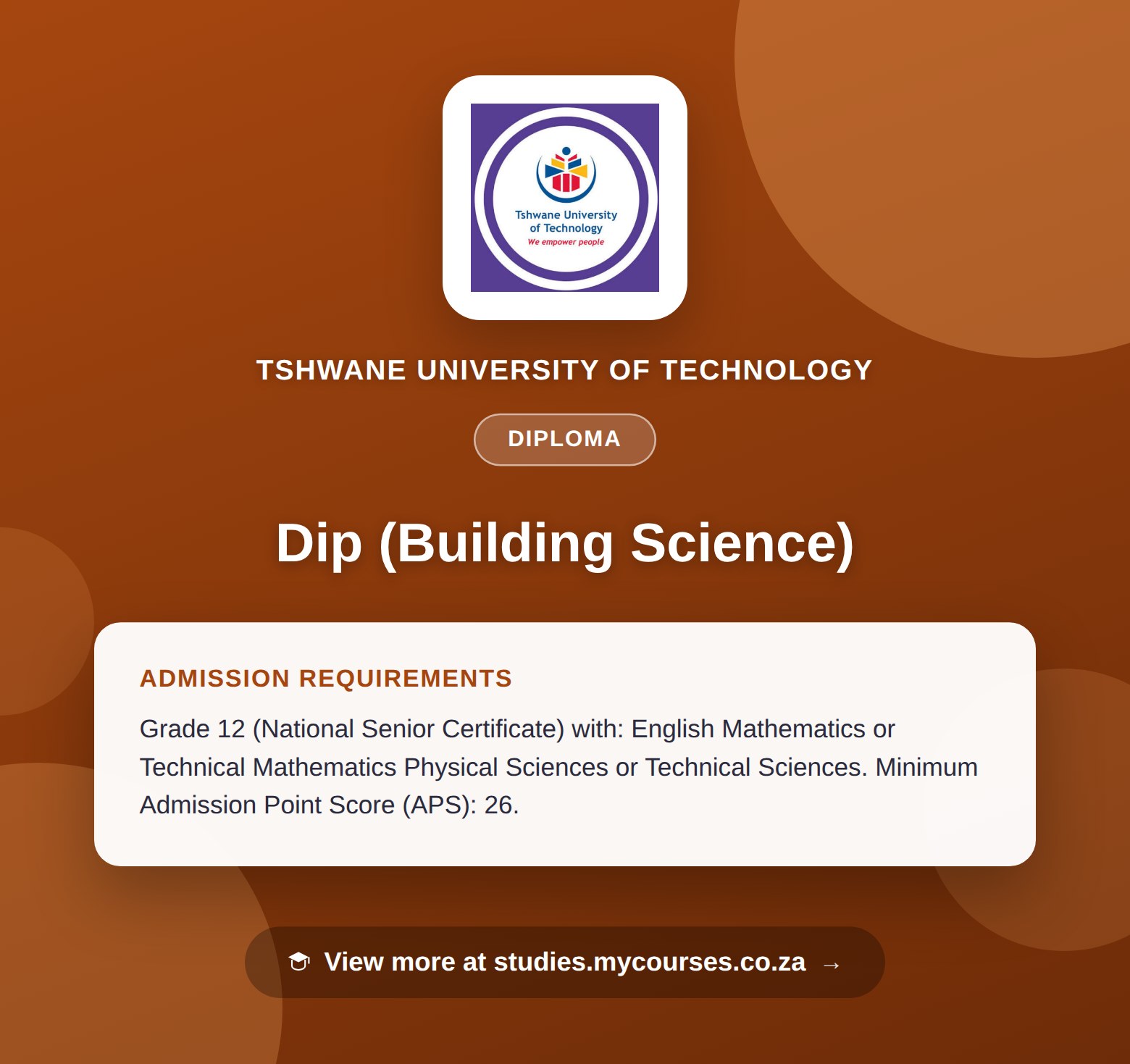
The Dip (Building Science) is a diploma offered by TUT for 2027 learners, taking 3 years to complete. This page covers the Grade 12 subjects and admission score you need to qualify, what the course involves, where you can study it, the careers it leads to, and how to apply.
Grade 12 Required Subjects to study Dip (Building Science) at TUT
- Grade 12 (National Senior Certificate) with: English Mathematics or Technical Mathematics Physical Sciences or Technical Sciences
- Minimum Admission Point Score (APS): 26
About this course
This diploma in Building Science, offered through TUT's Faculty of Engineering and the Built Environment, runs over 3 years of full-time study. Graduates are prepared for practical, career-focused roles such as construction manager, technician quality surveyor, clerk of works, building inspector, in line with TUT's applied, industry-linked approach to education. Students who complete this qualification successfully can typically progress to further studies such as AdvDip (Construction Management) or AdvDip (Quantity Surveying), PGDip (Quantity Surveying) and MBuiSci.
Possible careers
Course intelligence for Dip (Building Science)
Data-driven planning insights for this specific course: job market outlook, NSFAS funding, and how competitive admission is likely to be.
Job market outlook
Good sign: Surveyor appears on South Africa’s National List of Occupations in High Demand, a Department of Higher Education and Training analysis of employer hiring activity. Employers have been reporting real recruitment pressure for this role, which generally works in your favour once you’ve completed Dip (Building Science).
NSFAS funding
As a Diploma at TUT, a public institution, this course generally falls within NSFAS’s undergraduate funding scope. Funding is means-tested and not automatic, so confirm your own eligibility at nsfas.org.za before relying on it.
Admission chances
TUT’s intake and this course’s requirements with its published admission requirements generally leave more room than the most sought-after courses, so you likely have a reasonable window to apply without rushing, though applying early is always the safer bet.
These insights are estimates generated from South Africa’s National List of Occupations in High Demand (DHET, November 2023 draft), NSFAS’s published funding rules, and this university’s general applicant demand. They’re planning guidance, not a guarantee. Always confirm funding and admission specifics directly with TUT and NSFAS.
How to apply for 2027 studies
Apply directly through TUT's online application system at https://www.tut.ac.za/study-at-tut/ (application fee of R240 payable once-off for first-time applicants).
Ready to apply? This takes you straight to Tshwane University of Technology’s own official application page.
Apply NowYou will leave studies.mycourses.co.za and apply directly with Tshwane University of Technology.
- Applications for 2027 studies
- Open: 3 April 2026
- Close: 31 July 2026
View all Courses at TUT
- Duration
- 3 years
- NQF Level
- 6
- APS / Points
- 26
- Campus
- Pretoria, Pretoria
What Courses Do I Qualify For in South Africa?
Enter your own subject marks and we'll show you real courses you're likely to qualify for, right now, plus what those courses tend to lead to: how in-demand the work is, whether NSFAS is likely to fund it, and how competitive admission is.
Related courses

Source: tshwane-university-of-technology.json, last verified 2026-08-22. Requirements and fees change. Always confirm current details directly with Tshwane University of Technology before applying.