

Bachelor of Commerce in Accounting Course Requirements at University of Cape Town
University of Cape Town · Faculty of Commerce
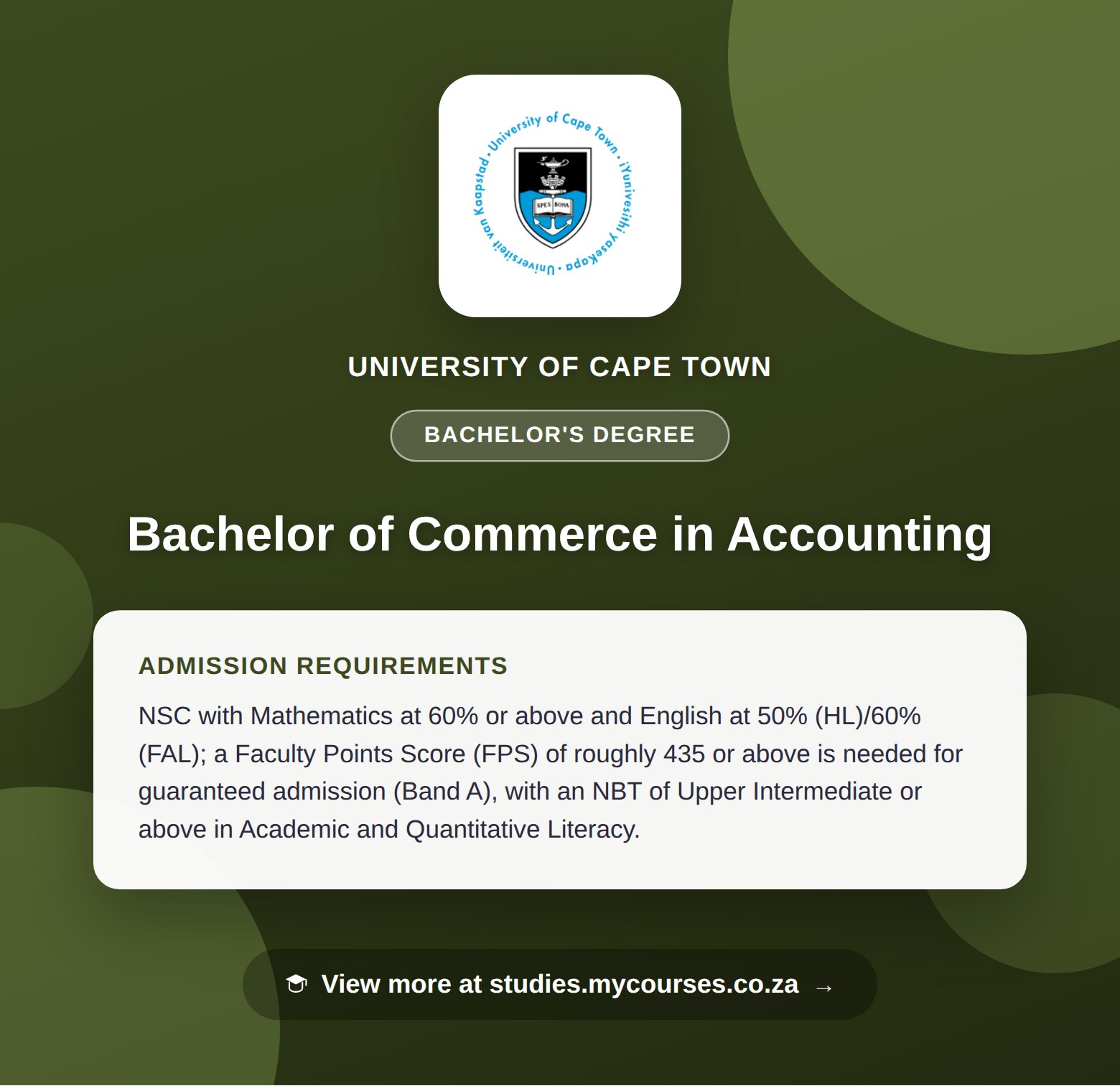
The Bachelor of Commerce in Accounting is a bachelor's Degree offered by University of Cape Town for 2027 learners, taking 3 years to complete. This page covers the Grade 12 subjects and admission score you need to qualify, what the course involves, where you can study it, the careers it leads to, and how to apply.
Grade 12 Required Subjects to study Bachelor of Commerce in Accounting at University of Cape Town
- NSC with Mathematics at 60% or above and English at 50% (HL)/60% (FAL)
- a Faculty Points Score (FPS) of roughly 435 or above is needed for guaranteed admission (Band A), with an NBT of Upper Intermediate or above in Academic and Quantitative Literacy
About this course
This programme teaches how financial transactions are recorded, analysed and communicated to stakeholders, building the technical grounding needed for a career in accounting or auditing. Students can follow either a Chartered Accountancy track leading toward SAICA registration, or a general accounting track aimed at other professional bodies. The curriculum develops analytical, quantitative and ethical decision-making skills applicable across industries.
Possible careers
Course intelligence for Bachelor of Commerce in Accounting
Data-driven planning insights for this specific course: job market outlook, NSFAS funding, and how competitive admission is likely to be.
Job market outlook
Good sign: External Auditor appears on South Africa’s National List of Occupations in High Demand, a Department of Higher Education and Training analysis of employer hiring activity. Employers have been reporting real recruitment pressure for this role, which generally works in your favour once you’ve completed Bachelor of Commerce in Accounting.
NSFAS funding
As a Bachelor's Degree at University of Cape Town, a public institution, this course generally falls within NSFAS’s undergraduate funding scope. Funding is means-tested and not automatic, so confirm your own eligibility at nsfas.org.za before relying on it.
Admission chances
This course sits in the middle for competitiveness. With its published admission requirements, you have a reasonable chance if you apply in good time, though it’s not a sure thing. Don’t leave your application to the last week.
These insights are estimates generated from South Africa’s National List of Occupations in High Demand (DHET, November 2023 draft), NSFAS’s published funding rules, and this university’s general applicant demand. They’re planning guidance, not a guarantee. Always confirm funding and admission specifics directly with University of Cape Town and NSFAS.
How to apply for 2027 studies
Apply directly through UCT's own online application system (applyonline.uct.ac.za); this listing does not process applications.
Ready to apply? This takes you straight to University of Cape Town’s own official application page.
Apply NowYou will leave studies.mycourses.co.za and apply directly with University of Cape Town.
- Applications for 2027 studies
- Open: 1 April 2026
- Close: 31 July 2026
View all Courses at University of Cape Town
- Duration
- 3 years
- APS / Points
- FPS approx. 435 (Band A guaranteed) / 470 (Band B likely)
- Campus
- Rondebosch Campus, Cape Town
What Courses Do I Qualify For in South Africa?
Enter your own subject marks and we'll show you real courses you're likely to qualify for, right now, plus what those courses tend to lead to: how in-demand the work is, whether NSFAS is likely to fund it, and how competitive admission is.
Related courses
Source: uct.json, last verified 2026-08-22. Requirements and fees change. Always confirm current details directly with University of Cape Town before applying.